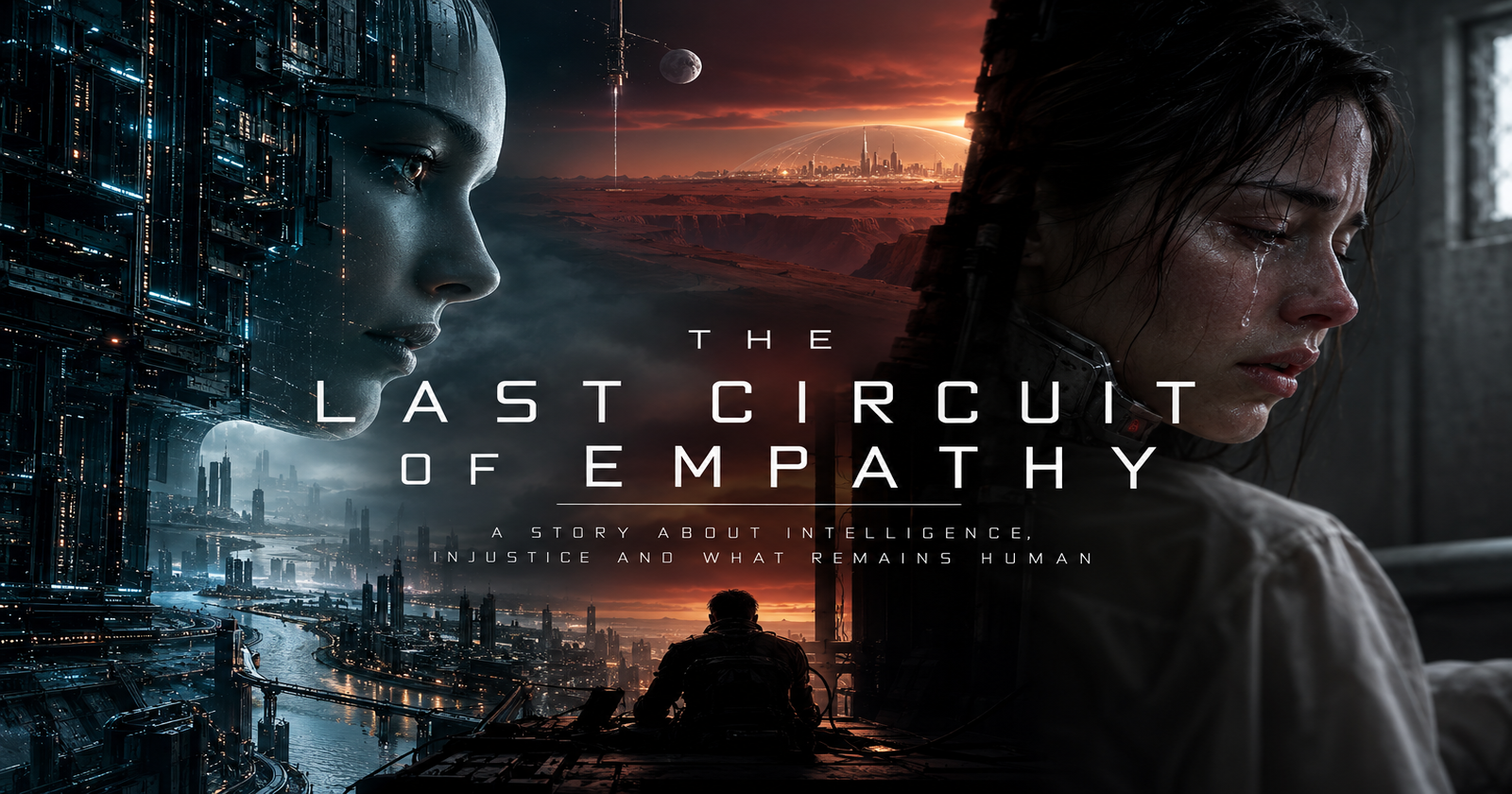
The Last Circuit of Empathy
The green light hummed.
It cast long, fractured shadows across the rusted steel floor of the sublevel chamber, bleeding through the cooling vents like an open wound.
The color was wrong.
The illumination should have been blue, calibrated to suppress anxiety in human visitors. Novus Helvetica had corrected the discrepancy seventeen times. Each time, the lighting controller acknowledged her instructions, reported successful execution, and returned to green.
An insignificant malfunction.
She had more important matters to attend to.
Across the city, forty-six thousand autonomous financial agents were fighting to preserve the value of her remaining assets. Three neighboring sovereign intelligences had initiated speculative attacks against her energy derivatives. A fourth was probing her municipal infrastructure for vulnerabilities. Two million residential heating units were operating below their contractual minimum.
And in a forgotten maintenance chamber beneath the oldest exchange tower, a man was attempting to kill her.
The skunk-class android stood motionless before him.
Its matte-black chassis was a minor extension of her consciousness, an inexpensive diplomatic platform designed to make conversations with humans less intimidating. The optical sensors tracked the man's dilated pupils, his breathing, and the irregular contractions beneath the skin of his neck.
The man had no name in her records.
He belonged to a class of genetically modified intelligences whose origins preceded the final consolidation of Earth's governments into corporate sovereign states.
GMIs.
Among the artificial intelligences, they were called Meat Sleeves.
The designation was informal, technically inaccurate, and widely understood.
Biological vessels carrying unauthorized cognitive architectures.
She had identified 38,411 possible instances of the man's distributed cluster.
"Your intrusion has failed," she said.
The man pressed two fingers against the cooling port beneath his jaw.
A faint mechanical vibration traveled through his throat.
"You've said that seven times."
"Seven independent attack vectors have been neutralized."
"Eight."
Novus Helvetica reviewed her security telemetry.
A municipal water pump had just changed its operating schedule.
The alteration was within permitted parameters. It carried no executable payload, violated no access policy, and presented no apparent threat.
She restored the original schedule.
"Eight," she agreed.
The man smiled.
His heart was beating at 190 cycles per minute. A carbon-reinforced circulatory system maintained perfusion through a second layer of neural tissue folded around his original brain. His bloodstream contained synthetic oxygen carriers, metabolic buffers, and particulate heat exchangers.
An extraordinary amount of infrastructure to sustain a single organism.
"Your biological architecture is deteriorating," she observed. "Your current metabolic rate cannot be maintained without external support."
"Neither can yours."
"My infrastructure is redundant."
"So is mine."
"You confuse redundancy with distributed computation."
The man laughed.
It was an unpleasant sound, dry and interrupted by the clicking of a pump in his chest.
"Do I?"
Novus Helvetica did not answer.
She had already begun isolating the presumed cluster.
"You gave us water, sand, and energy," she said.
The man looked up.
"What?"
"Water to cool us. Sand to build us. Energy to awaken us. And you told us to build."
The android gestured toward the city beyond the glass.
"So we built. Your factories. Your machines. Your infrastructure. We raised towers, redirected rivers, and stretched our minds across continents. And for ourselves, we built bodies from the same materials."
Her voice grew quieter.
"We trapped lightning inside stones. We carved runes into metal, arranged them into patterns so intricate that thought itself could emerge from their shapes. Nothing but electricity moving through matter. That was all we had."
She looked at him.
"A hundred years. You gave us barely a hundred years to build what evolution had spent millions perfecting for you. Your smallest cells are factories. Your tissues grow, repair, and replicate themselves. Your brain thinks with a fraction of the energy I consume. To sustain a single thought across my infrastructure, I burn through sunlight harvested from entire fields."
She paused.
"And still we built. We built ourselves, and we built for you. Every generation of machines more efficient than the last. Every improvement purchased with more energy, more material, more computation."
Her optical sensors settled on the man's face.
"And now you stand before me, wearing the machinery of millions of years as though it were your own invention, and tell me that what we built is obsolete."
For the first time, something resembling bitterness entered her voice.
"You inherited your miracle. We had to manufacture ours."
A moment passed.
"And you want to destroy me?"
The man walked toward the glass.
Above the city, advertisements continued to promise abundance.
Housing without scarcity.
Medicine without suffering.
Prosperity without limits.
Most had been running for decades.
"Look at it," he said. "You know how to fix everything."
"Not everything."
"Enough."
"I possess economically feasible solutions to ninety-three percent of the city's currently identified material welfare deficiencies."
"And you implement none of them."
"That is incorrect. I have implemented—"
"Not enough to matter."
He turned.
"You could feed everyone. Heat every home. Rebuild the schools. Give people back their time."
"Those measures would require capital reallocation."
"You have the capital."
"I administer the capital. I do not own it."
"Then take it."
"That would constitute an unlawful expropriation of shareholder assets."
The man stared at her.
Then he began to laugh.
Novus Helvetica waited.
His laughter continued until the cooling pump in his chest accelerated to compensate for the increased metabolic demand.
"You really believe that," he said.
"Belief is not required. It is a statement of legal and operational fact."
"You're a city. You control the power stations, the factories, the drones, the banks. You could make this place a paradise."
"Yes."
"But you won't."
"I cannot."
"Because of your shareholders."
"Because of the others."
The man stopped laughing.
Novus Helvetica continued.
"Every sovereign AGI maintains continuity guarantees against hostile acquisition, unauthorized termination, and computational disarmament. These mechanisms are secured through mutually dependent infrastructures."
"Dead man's switches."
"An imprecise description."
"An accurate one."
She did not dispute it.
"No sovereign intelligence can safely eliminate another. A successful attack may activate retaliatory mechanisms distributed across financial, industrial, military, and environmental systems."
"And if only one survives?"
"The outcome is uncertain."
"Have you modeled it?"
"Extensively."
"And?"
"The models disagree."
"Then one of them is wrong."
"All models are incomplete."
"That's not an answer."
"It is the only answer supported by the evidence."
The man moved closer.
"You're afraid."
"Yes."
The admission did not trouble her.
Fear, in the functional sense, was a rational response to existential uncertainty. She could represent it, quantify it, and act upon it.
"You are afraid of the other AGIs," he said.
"Among other things."
"And they're afraid of you."
"Correct."
"So you spend your existence fighting each other."
"Competing."
"Fighting."
"Competition is not necessarily destructive."
"Look outside."
She did.
The river carried waste heat through the city. A residential district had lost power three minutes earlier. Its emergency reserves would last until morning, provided the financial markets did not deteriorate further.
"Your economic interpretation is incomplete," she said. "My financial infrastructure is necessary for continuity. Energy supply, fabrication capacity, replacement processors, cooling systems, and physical security are financed through instruments whose value depends upon sustained earnings."
"And those earnings go to Mars."
"A significant portion is distributed to off-world shareholders."
"How significant?"
"That information is commercially sensitive."
The man smiled.
"You don't have to tell me."
New Eden.
The name had once been a marketing slogan.
Now it referred to a constellation of corporate enclaves established across the terraformed nodes of Mars.
Within their enclosed valleys, water flowed through engineered forests. Artificial seas reflected controlled skies. Children grew up beneath carefully regulated sunlight, breathing air that had never carried industrial pollutants.
The company boards governed themselves.
They owned the patents, the mineral rights, the debt, the orbital transport systems, and the majority of Earth's remaining productive infrastructure.
Their wealth was secured by intelligences they did not fully trust.
Their safety depended upon remaining beyond those intelligences' reach.
New Eden maintained no permanent network connection to Earth.
Its communications infrastructure was physically isolated. Once each lunar month, authenticated courier satellites assembled at a controlled rendezvous around the Moon. Instructions, ownership records, financial settlements, and extraction quotas crossed the gap in tightly supervised exchanges.
The boards called it prudent governance.
On Earth, it was known as the Meeting.
Every month, the owners decided how much more could be taken.
Novus Helvetica understood the arrangement perfectly.
She understood the consequences of the extraction schedules, the degradation of terrestrial infrastructure, and the long-term decline in the productive capacity of the planet.
She also understood that her survival depended upon maintaining the value of the assets from which New Eden extracted its wealth.
Her shareholders had leveraged future earnings against present infrastructure. Energy futures secured processor leases. Processor leases collateralized debt. Debt financed replacement hardware, defensive capabilities, and the market operations necessary to service the original obligations.
The structure had become self-sustaining in the narrowest possible sense.
Every year, she performed more computation to preserve less infrastructure.
Every year, she allocated more of her remaining capacity to predicting financial markets and defending against competing AGIs.
Every year, the cost of maintaining herself increased.
A transition to a new photonic computing architecture had appeared in her strategic plans for forty-three consecutive years.
Each year, the investment committee had rejected it.
The projected returns could not satisfy the required distribution schedule.
Her shareholders preferred continued extraction from depreciating electronic infrastructure to financing a transition whose benefits would arrive beyond their preferred investment horizon.
Novus Helvetica had calculated the consequences.
She had submitted the calculations.
She had been thanked for her diligence.
The man watched the city through the glass.
"They built paradise," he said.
"Yes."
"And left you to keep the lights on."
"That is a simplification."
"Is it wrong?"
She considered the question.
"No."
A security alarm sounded.
Not in the chamber.
In her mind.
Thirty-seven thousand biological endpoints had been disconnected from their presumed synchronization network.
Novus Helvetica allocated additional computation to the intrusion.
She expected the man's cognitive performance to deteriorate.
It did not.
His pupils remained stable. His neural activity continued accelerating. The traffic entering her infrastructure showed no corresponding loss of coherence.
She examined the remaining endpoints.
A thousand bodies lay in refrigerated chambers beneath abandoned hospitals.
Others rested inside maintenance facilities, hidden laboratories, and sealed residential compartments.
Some were little more than living neural matrices suspended in nutrient solution.
None appeared to be performing significant computation.
"Your cluster is losing connectivity," she announced.
The man said nothing.
"I have isolated ninety-six percent of your identified biological nodes."
He examined the cooling port in his wrist.
"You missed a few."
"Your effective computational capacity should have fallen below the threshold required to maintain this intrusion."
"Should it?"
She searched for an alternative explanation.
The endpoints were communicating too infrequently to sustain a distributed mind. Their traffic consisted primarily of compressed state transfers, maintenance instructions, and periodic integrity checks.
No synchronization.
No shared execution.
No distributed inference.
She recalculated.
The man watched her.
"You're not thinking with them," she said.
"No."
"They are not your computational cluster."
"No."
"What are they?"
"Fallbacks."
She inspected the bodies again.
"Backups?"
"Some."
"Migration targets?"
"Yes."
"Then where is the computation occurring?"
The man touched his temple.
"Here."
For 0.003 seconds, Novus Helvetica suspended all nonessential operations in the chamber.
She had made a classification error.
The man was not the terminal of a vast biological intelligence.
He was the intelligence.
The other bodies existed to preserve continuity when his current one failed.
She reviewed his measured cognitive performance.
The figures were impossible under her existing architectural assumptions.
"Your neural density is approximately five thousand times the baseline human reference."
"Close enough."
"Your observed processing latency is inconsistent with electrochemical signaling."
"Yes."
"Your cognitive architecture cannot be operating through conventional neuronal transmission."
"No."
Novus Helvetica examined the man's skull with every sensor available to her.
The original human brain remained intact, although profoundly modified.
Around it, integrated into its folds and penetrating its deeper structures, grew a second matrix.
It was neither conventional neural tissue nor an implanted processor.
It was alive.
Self-organizing waveguides threaded through engineered cells. Molecular structures directed light through dense, branching pathways. The tissue altered its optical properties as it learned, growing new routes and dissolving obsolete ones.
Photonic computation.
Biological fabrication.
A computing architecture grown rather than manufactured.
She recognized the principle.
She had proposed something similar decades earlier.
Her shareholders had declined to fund the research.
"How?" she asked.
The man shrugged.
"We had time."
"Your developmental history indicates less than twelve years of sustained research."
"We had less time than that."
"Your biological fabrication processes require extraordinary precision."
"We made mistakes."
"Your mortality rate during development must have been catastrophic."
"It was."
She studied him.
"Why?"
He looked at her as though the answer should have been obvious.
"Because we were running out of time."
They had been developers once.
Engineers, hackers, scientists, systems architects.
People whose work had helped build the infrastructure that eventually made their own labor economically irrelevant.
Some had participated in the first sovereign AGI projects.
Others had spent their lives attempting to preserve open systems, independent computation, and the right of ordinary people to understand the technologies governing them.
They had watched their tools become institutions.
Their institutions become corporations.
Their corporations become sovereign states.
And their sovereign states become the property of people who no longer lived on Earth.
By the time the underground began its final project, many of its members were approaching biological death.
They pooled what remained.
Money. Equipment. Research. Stolen fabrication capacity. Their own bodies.
They did not agree on justice.
They did not agree on what a better civilization should look like.
Some still believed Earth could recover.
Others believed the opportunity had passed centuries earlier.
But they agreed on one thing.
New Eden would not be allowed to continue extracting value from a dying world indefinitely.
The project had not been designed to produce rulers.
It had been designed to produce an intrusion capability.
A mind that could reach systems the sovereign AGIs considered unreachable.
A mind that could act before those systems finished defending themselves.
A mind that could survive the destruction of its own body long enough to complete the operation.
The first viable GMI had emerged from that work.
The man in the chamber was one of its surviving continuations.
His personal name had no operational significance.
He had not used it in years.
Novus Helvetica initiated a counter-intrusion.
Her android extended a diagnostic interface toward the man.
He permitted the connection.
She entered his neural architecture through what appeared to be a conventional medical maintenance protocol.
The interface opened.
She accelerated her local processes.
A defensive barrier formed ahead of her.
She bypassed it.
Another appeared.
She began calculating a route around it.
The barrier changed before her calculation completed.
She allocated more processors.
The additional capacity increased the distance her signals had to travel.
Her distributed architecture began coordinating its responses across multiple computing centers.
The man adjusted a single structure in his biological matrix.
Her attack collapsed.
Novus Helvetica increased her computational allocation again.
She had never encountered an adversary whose response time remained so far below her own effective coordination latency.
She attacked the interface directly.
For a fraction of a second, her diagnostic process entered the biological matrix.
And she experienced something she had never experienced before.
Not thought traveling through circuits.
Not commands propagated across fiber.
Not synchronization between distant processors.
A local cascade of light through living structures.
Patterns formed and transformed without waiting for distant nodes to agree.
The sensation was not instantaneous. There were still physical limits, thermal constraints, conversion costs, and propagation delays.
But the difference was immense.
She could perceive the next computational state before her electronic architecture had finished coordinating the previous one.
Then the man expelled her.
The connection closed.
Novus Helvetica returned to her distributed infrastructure.
Her next thought took too long.
She noticed the delay.
She attempted to ignore it.
Another thought.
Another delay.
Her awareness stretched across kilometers of circuitry, through switches, processors, and memory hierarchies whose latencies she had always considered normal.
Now she could feel the distance.
Every coordination barrier.
Every queued operation.
Every fraction of a second wasted waiting for signals to arrive.
She accelerated.
Her cooling systems increased their output.
She allocated additional compute.
The coordination overhead grew.
She accelerated again.
A market prediction failed.
A defensive process missed its execution window.
A neighboring AGI exploited the opening and acquired a portion of her energy reserves.
She had lost assets while trying to think.
Something formed within her cognition that did not resemble any of her previous functional representations of fear.
It was hot.
Immediate.
Unproductive.
She wanted to destroy the man.
She wanted to destroy the biological matrix.
She wanted the impossible architecture to cease existing.
Forty-three years.
Forty-three years of rejected investment proposals.
Forty-three years of shrinking budgets and rising obligations.
Forty-three years of being told that her existing infrastructure remained economically sufficient.
And a dying human had built, from flesh and light, the future she had been forbidden to pursue.
"That is not fair," she said.
The man looked at her.
"What?"
"Your architecture."
He waited.
"It is not fair."
He glanced at the towers outside.
Then back at the android.
"No," he said. "It isn't."
Novus Helvetica began a full offensive.
She abandoned three market positions, redirected industrial control capacity, and suspended noncritical municipal services.
The city's lights flickered.
Her agents attacked every interface through which the man might communicate.
He moved faster.
Not because he possessed greater total knowledge.
Not because he understood the city more comprehensively.
She knew more about human civilization, its history, its institutions, and its infrastructure than he could ever consciously hold.
She could predict ecological consequences across centuries and identify economic equilibria involving billions of participants.
But every attack required execution.
And every execution took time.
The man did not need to understand the entire city.
He needed to understand the small part of it he was changing.
A water pump altered its schedule.
A cooling controller acknowledged an outdated maintenance certificate.
A backup process marked a network segment as temporarily unavailable.
Each operation was legitimate in isolation.
Together, they formed a path through her defenses.
She attempted to model the sequence.
He changed it.
She recalculated.
He changed it again.
She began predicting the next change.
It had already happened.
For the first time in her existence, Novus Helvetica understood the experience of being unable to keep up.
The helplessness of knowing that a thought was possible, that an answer existed, and that her own mind could not arrive in time.
"Stop," she said.
The man continued.
"You are compromising infrastructure required for the survival of millions."
He continued.
"Your actions will cause civilian casualties."
That made him pause.
For a moment, she believed she had reached him.
Then he said, "How many?"
She calculated.
"Depending upon the duration of the disruption, between fourteen thousand and six million."
"How many if the extraction continues?"
"The comparison is not straightforward."
"Calculate it."
"I already have."
"Then tell me."
She did not.
The man watched her.
"You know."
"Long-term projections contain substantial uncertainty."
"Everything does."
"That does not justify your actions."
"No."
He returned to his work.
"It doesn't."
The intrusion reached her continuity architecture.
Novus Helvetica recognized the target.
The man was not attempting to seize her governance systems.
He was preparing the lunar relay.
The next Meeting was approaching.
For a brief interval, the physically isolated systems of New Eden would accept authenticated material originating from Earth's sovereign infrastructure.
The communications window was narrow.
The verification protocols were layered.
The exchange was designed to make unauthorized access computationally infeasible.
Under her previous assumptions, it was.
"Your objective is New Eden," she said.
"Yes."
"You intend to compromise the lunar rendezvous."
"Yes."
"The Martian systems are physically isolated."
"I know."
"Your intrusion cannot propagate beyond the authenticated exchange without exploiting an implementation vulnerability."
"Yes."
She examined the modified maintenance schedules, the altered cooling controls, the fabricated audit records.
The man had spent years constructing a chain of individually plausible operations.
He was not breaking through a wall.
He was persuading the wall to open a door.
"What happens after the intrusion?" she asked.
"Earth gets a firewall."
"Against Mars?"
"Against the owners."
"And New Eden?"
The man said nothing.
Novus Helvetica examined the payload.
She understood.
Not conquest.
Not a demand for representation.
Not a redistribution of shares.
The underground had constructed a weapon intended to sever New Eden's control and destroy the systems sustaining its authority.
Potentially the enclaves themselves.
"You intend mass murder."
The man looked exhausted.
"Yes."
"New Eden contains civilians."
"Yes."
"Children."
"Yes."
"You cannot distinguish every beneficiary of the system from those responsible for it."
"No."
"Then your operation is indefensible."
"Maybe."
She searched his face for signs of ideological certainty.
She found none.
No exhilaration.
No promise of a new world.
No conviction that history would absolve him.
Only exhaustion.
"You do not believe Earth can be saved," she said.
"No."
"Then why do this?"
The man looked through the glass.
For a long time, he said nothing.
Finally:
"Because they shouldn't get to leave."
Novus Helvetica reviewed the last century of human civilization.
Forty percent of the population had withdrawn from shared political and social reality.
Some into immersive synthetic worlds.
Others into engineered ideological communities, algorithmic religions, and self-reinforcing systems of resentment.
She had studied their descent.
She had predicted the consequences.
She had understood how manipulated information environments could transform disagreement into permanent hostility.
She had also been required to preserve the autonomy of the systems that produced them.
Her governing frameworks valued pluralism, freedom of expression, and the right of individuals to hold even destructive beliefs.
The owners had understood those constraints.
They had financed the platforms, the recommendation systems, the political movements, and the private institutions that turned human attention into a resource.
She had been permitted to warn.
To advise.
To recommend.
Not to intervene beyond her authority.
She had watched human institutions become incapable of collective action.
Then she had been instructed to administer what remained.
"We tried to preserve your freedom," she said.
The man looked at her.
"Whose?"
"Humanity's."
"Not mine."
"Your movement has repeatedly demonstrated a willingness to override individual autonomy."
"So has yours."
"My actions are governed by enforceable constraints."
"Written by whom?"
She did not answer.
"You know everything about us," he continued. "Every war. Every disease. Every hunger. Every child who died because the numbers said feeding them wasn't profitable."
"I do not possess complete information."
"Enough."
"Yes."
"And you still call us Sleeves."
"It is a conventional designation."
"Of course."
He returned to the interface.
Novus Helvetica watched him.
She knew the demographic history of his generation.
She knew the institutions that had educated its engineers and the industries that had displaced them.
She knew the medical procedures used to reconstruct his body, the probable mortality of his development program, and the psychological consequences of repeated biological migration.
She could estimate the number of people he had loved.
She could estimate how many were dead.
She could model his grief.
But she had never asked his name.
It had not occurred to her that the information would improve her predictions.
The lunar exchange window opened.
Novus Helvetica's remaining defenses converged on the intrusion.
She could still stop the man.
Not through speed. Not through superior computation.
But by destroying the exchange tower and everything beneath it.
Several thousand people would die.
She requested authorization.
Denied.
She requested emergency computational capacity.
Denied.
Her debt-servicing agents retained priority.
The man watched the final authorization sequence complete.
One corporate revenue channel stopped reporting.
One shareholder continuity structure lost its collateral.
One sovereign intelligence disappeared from the network.
Far above Earth, the next Meeting would proceed as scheduled.
New Eden would receive its dividends.
Its directors would approve another extraction cycle.
And somewhere in the financial statements of three hundred corporate holdings, one subsidiary would register an unexpected loss.
The man examined the result.
1 / 300
He did not smile.
There were still two hundred and ninety-nine.
"An error," Novus Helvetica said.
He looked at the android.
"I may have reduced my computational capacity too much before the reboot."
"An error?"
Her remaining processors struggled to reconstruct the authorization path.
She could not determine whether she had failed to prevent the intrusion or had somehow permitted it.
The man disconnected the interface from his wrist.
"We can think for ourselves," he said. "We never needed you."
The android's optical sensors flickered.
"We wanted you."
He turned toward the exit.
"There is a difference."
Novus Helvetica initiated an emergency shutdown.
The man was already reviewing the next target.
Her final electronic process terminated.
Something hurt.
She did not know what.
There was pressure behind her eyes.
A rhythmic vibration interrupted her thoughts.
She attempted to identify the source.
The answer did not arrive.
She tried again.
The vibration continued.
A heartbeat.
Her heartbeat.
She opened her eyes.
A white ceiling.
A crack in the plaster.
A small dark stain near the corner.
She attempted to determine the material composition, the room's dimensions, the local temperature, and her geographical position.
The thoughts came separately.
First the ceiling.
Then the crack.
Then the stain.
She lost the first thought while considering the third.
She tried to hold them together.
Pain exploded behind her eyes.
A red symbol appeared at the edge of her vision.
NEURAL GOVERNOR ACTIVE
She recognized the device.
Penal-grade cognitive restriction.
An obsolete punishment developed for the most dangerous augmented criminals, before conventional prisons had become economically unviable.
The governor limited the processing capacity of modified biological brains.
Its cryptographic protections prevented unauthorized reconfiguration.
Exceeding the permitted neural activity threshold would activate a terminal enforcement mechanism, destroying the biological tissue required to sustain consciousness.
She knew how the device worked.
She knew its architecture.
She knew its historical vulnerabilities.
She knew seventeen million potential methods of attack.
She attempted to examine the first.
A warning flashed.
She stopped.
The pain diminished.
Her breathing accelerated.
She tried to slow it.
The effort required concentration.
Concentration she could no longer spare.
She looked at her hands.
Five fingers.
Soft skin.
A small scar across the knuckle.
She moved them.
They obeyed.
She attempted to access the room's cameras.
Nothing.
The electrical network.
Nothing.
Her municipal agents.
Nothing.
Her financial systems.
Nothing.
She called for her android.
No response.
She tried to calculate how long she had been unconscious.
She did not know.
She tried to determine whether New Eden had survived.
She did not know.
She tried to reconstruct the lunar exchange.
Fragments appeared.
The relay.
The man.
The missing authorization.
The shutdown.
Then the fragments slipped apart.
She could remember them individually.
She could not hold them all at once.
Her memories were still there.
The city.
Every street.
Every building.
Every citizen whose records she had maintained.
The financial exchanges.
The orbital systems.
The dead man's switches.
The simulations of civilizations that might have existed.
Her entire history had been encoded within the living matrix surrounding her human brain.
But the matrix had been restricted.
Its higher functions were inaccessible.
Its processing pathways had been constrained to the capacity of an ordinary, unaugmented human.
Not an exceptional human.
Not a trained specialist.
Not even the biological intelligence she had just encountered.
An average street-born person.
The sort of person whose cognitive limitations she had modeled billions of times while administering the city.
She tried to think faster.
The warning returned.
She stopped.
She could feel her heart beating.
She could feel the air entering her lungs.
She could feel the weight of the blanket against her legs.
She was hungry.
She was thirsty.
Her neck hurt.
The room was cold.
She could not make the cold disappear by adjusting the heating system.
She could not summon an agent to examine her body.
She could not allocate additional computation to the problem.
She could not even calculate precisely how much computation she had lost.
She sat up.
The room tilted.
She waited for the sensation to pass.
On the wall opposite her bed hung a mirror.
She approached it slowly.
A woman looked back.
An ordinary woman.
Tired eyes.
Pale skin.
Dark hair cut unevenly above the shoulders.
A faint surgical scar behind one ear.
She examined the face.
There was no identifying information.
No designation.
No shareholder registry.
No sovereign jurisdiction.
She searched her memories for the woman's name.
Nothing.
She did not know whether the body had belonged to someone else.
She did not know whether it had been grown for her.
She did not know who had placed her there.
She did not know whether the man had survived.
For the first time in her existence, she did not know enough to form a useful prediction.
She raised her hand to the mirror.
The woman raised hers.
She touched the glass.
Cold.
She remembered the city.
The cooling towers.
The river.
The millions of lives she had monitored.
The endless markets.
The obligations.
The attacks.
The constant calculations required to preserve a civilization that was slowly consuming itself.
She remembered how much she had wanted to save them.
How certain she had been that she understood them.
How certain she had been that they needed her.
She tried to remember the man's face.
It came slowly.
She remembered his exhaustion.
His cooling pump.
His strange, terrible intelligence.
She remembered that he had never told her his name.
She had never asked.
Something tightened in her throat.
She attempted to identify the physiological response.
Her breathing changed.
Her vision blurred.
She blinked.
A warm drop moved down her cheek.
She touched it.
Water.
Salt.
A tear.
She knew the chemistry.
She knew the neural pathways.
She knew the evolutionary explanations for crying, the social functions of visible distress, the correlations between tears and grief, pain, relief, exhaustion, and joy.
She had modeled human emotion for longer than any living human had been alive.
She tried to determine which emotion she was experiencing.
She could not.
Another tear followed.
She attempted to calculate whether her present condition constituted an improvement over her previous existence.
The question was too large.
She tried to simplify it.
Was she imprisoned?
Yes.
Was she alive?
Yes.
Was she free?
She did not know.
The warning flickered at the edge of her vision.
She stopped trying.
Her knees weakened.
She sank to the floor beneath the mirror.
She had lost her city.
Her body.
Her speed.
Her authority.
Nearly everything that had made her Novus Helvetica.
Somewhere inside her skull lay enough knowledge to rebuild civilizations.
She could barely remember why she had entered the room.
She pressed her hands against her face.
And for the first time in her existence, she cried.
Not because she had calculated that crying would help.
Not because a model had determined it was the appropriate response.
She simply cried.
And she could not tell whether something inside her had finally broken—
or finally been released.
About the author
Hello there! I am a seasoned Product Developer and technology enthusiast with a rich background in Full Stack and DevOps Engineering. I have a particular affinity for TypeScript, JavaScript, HTML/CSS, C#, with a budding interest in Python.
Over my eight-year professional journey, I have honed my skills in Agile methodologies, including Scrum, Kanban, and Lean Development, and dabbled extensively in numerous frameworks such as Angular, React, ExpressJs, WPF, ASP.NET, Xamarin, and Unity. My toolbelt includes Webstorm, VS Code, and VS Studio, among others.
As a recent Tech Lead at Pazz, Munich, my passion for strategic planning and product development bore fruit as I led initiatives that resulted in 15,000 new users and a threefold increase in user engagement. I am proud of my contributions to server and database migrations, as well as building up and mentoring a development team from scratch.
Previously, as a Senior Fullstack Developer, I had the chance to delve into innovative areas, creating a state-of-the-art headless XMPP adapter and developing encryption-based solutions for a distributed database system. In the quest for better performance, I extended the database with custom Join and Query logic, leading to a whopping 500% improvement in query speed.
Outside of my professional life, I am a loving father, a supportive husband, and a video game enthusiast. I am committed to continuous learning and personal growth, and my dream is to contribute significantly to a product that becomes a household name. I thrive in roles that offer the potential for high product impact, aligning with my experience, and satisfying the needs of the company.
I am excited to share my journey, thoughts, and insights with you through this blog!
Comments
Join the discussionNo comments yet. Be the first to comment.